Subtotal $0.00
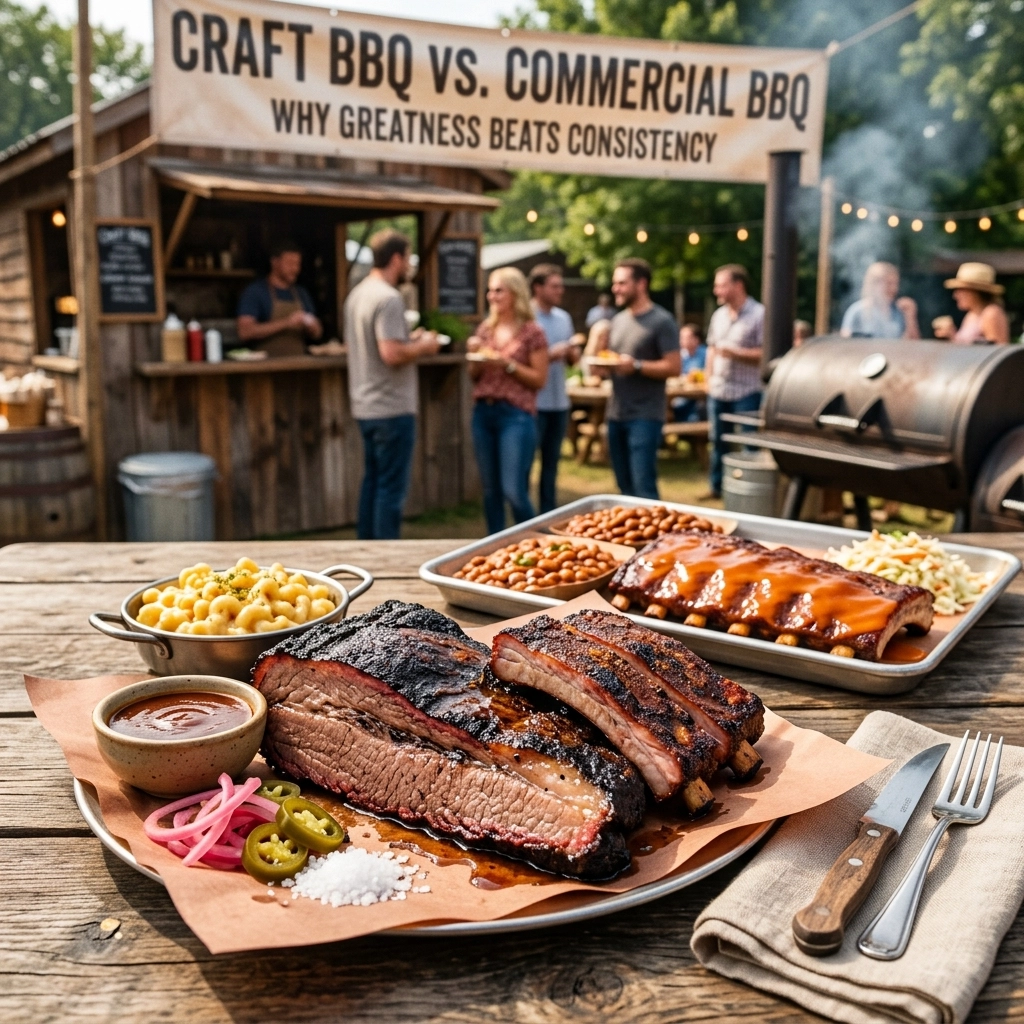
Barbecue is often categorized as a single type of cuisine.
In reality, two distinct worlds exist: Craft BBQ and Commercial BBQ.
One is built on systems. The other is built on fire, feel, and instinct.
When you are planning an event and looking for bbq catering ct, understanding the difference between these two approaches determines the outcome of your guest experience.
Commercial BBQ is built for low-cost structure. Craft BBQ is built for a specific event.
Neither is inherently "bad," but they serve entirely different purposes.
The Core Philosophy: Fire vs. Systems
At its most basic level, the difference between a craft operation like King of Que BBQ and a commercial giant like Mission BBQ comes down to how the heat is managed.
Craft BBQ: The Live-Fire Discipline
Craft BBQ is a responsive process. It requires a pitmaster to be physically present and mentally engaged with the fire throughout the entire cook.
- Fire Management: We manage the fire by hand in real time.
- Individual Attention: Every brisket is trimmed, seasoned, and monitored individually.
- Variable Adjustments: Pitmasters adjust airflow, fuel, and timing based on the specific piece of meat and the ambient weather conditions.
- Batch Focus: Cooking in smaller quantities allows for true bark development and deep smoke penetration.
In the world of ct bbq catering, this means the ceiling for quality is significantly higher.

Commercial BBQ: The Engineered Outcome
Commercial BBQ is built around low-cost structure. In many cases, the real volume driver is retail – walk-in lunch and dinner traffic – so catering operates inside a system that is primarily designed to support the counter first.
- Retail-First Flow: Production is often built around serving the line, with catering folded into that same operating model.
- Engineered Stability: Smokers are designed to maintain a static environment.
- Repeatable Timelines: The cooking process relies on controlled temperature systems and standardized procedures.
- Process Execution: Staff members follow a checklist rather than managing a live-fire craft.
- Low-Cost Structure: The priority is efficient throughput across day-to-day service, not a pit run curated for one client.
The result is approachable and predictable: but it is also capped in character.
The Marketing Truth: Cooking vs. Operating
There is a fundamental truth in how these two models are presented to the public.
Craft BBQ is responsive. Commercial BBQ is programmed.
When you choose a bbq catering connecticut specialist that focuses on craft, you are hiring someone to cook for you.
When you hire a commercial chain, you are often paying for a low-cost operating structure built around equipment, standardized flow, and retail demand. They operate equipment; we run pits.
This is an important distinction for event planners. A craft pitmaster reacts to the meat, the weather, and the fire. If a particular brisket needs another hour to render properly, it gets another hour.
A commercial system follows a calibrated timeline. When the timer goes off, the meat comes out, regardless of whether the fat has reached its peak rendering.
Flavor Nuance vs. Predictability
The primary goal of commercial barbecue is risk reduction.
By standardizing every variable, they ensure that the food is "good enough" every single time. It is a safe choice for those who prioritize uniformity above all else.
Craft BBQ prioritizes different metrics:
- Smoke Complexity: Using real wood logs produces a depth of flavor that electric or gas-assist smokers cannot replicate.
- Bark Texture: The interaction between dry rub, smoke, and airflow creates a distinct, crunchy exterior.
- Fat Rendering: Achieving the perfect "melt-in-your-mouth" texture requires instinctual timing.
For bbq danbury ct events, our angle is simple: our barbecue might vary slightly from day to day because it is a real, organic product.
That is exactly the point. We trade the safety of a factory setting for the possibility of a perfect bite.

Human Skill vs. Engineered Outcome
In a commercial setting, the system is the hero. If a staff member leaves, the system remains. The equipment does the heavy lifting.
In craft BBQ, the pitmaster is the hero.
Our BBQ is only as good as our pitmaster: and that is exactly why it is great.
The human element allows for a level of quality control that machines cannot match. A pitmaster can feel the resistance in a brisket with a probe and know exactly how much longer it needs. A machine only knows what time it is.
This human-centric approach is what transforms a standard meal into a pitmaster-crafted experience.
Exclusivity and the Scarcity of Quality
One of the most visible differences between these two worlds is how the cook is allocated.
Commercial BBQ is often designed to be always available for retail service. Their volume may be high, but much of that volume is tied to walk-in traffic. Catering can become one more channel sharing the same production system.
Craft BBQ operations, including King of Que BBQ, operate on a different logic:
- Curated for YOU: The pit run is dedicated to your catering order – not shared with a retail counter.
- Crafted for Crowds: We are built to handle event volume without giving up craft quality.
- Event-Driven: Our focus is on executing your menu for your guests at peak performance.
When it comes to connecticut bbq catering, that distinction matters. We are not pulling your event from a system built around walk-in sales. We are producing genuine barbecue crafted specifically for your event and no one else.

Why Consistency Isn't Always the Goal
Consistency is often praised in the food industry, and for a fast-casual lunch, it makes sense. You want your sandwich to taste the same every Tuesday.
But for a wedding, a corporate milestone, or a community celebration, the question is not just consistency. It is whether the barbecue was made specifically for your event or pulled from a broader operating system.
Commercial BBQ can offer a lower-cost structure, especially when its production is supported by steady retail traffic. That model works when efficiency is the main priority.
Craft BBQ is playing a different game. The cost can be higher, because the value is different. You are paying for genuine barbecue crafted specifically for your event, with the full attention of the pit run dedicated to your menu and your guests.
Positioning for Your Next Event
If you are choosing between bbq caterers in ct, ask yourself how you want the food to be produced.
If you want a lower-cost, retail-supported system that can fold catering into its existing operation, commercial BBQ is a functional choice.
If you want barbecue that is curated for YOU, craft BBQ is the better fit.
At King of Que BBQ, our position is simple – Crafted for Crowds. We handle volume, but we do it with craft standards. We don’t program our pits; we run them. Every brisket is cooked over real wood, managed by hand, and finished when it is ready: not when a timer says so.
We are a dedicated craft BBQ caterer. This means the entire pit run is focused on your catering order, not split between your event and a lunch or dinner line. For ct bbq catering, that is the difference between shared production and true event-specific barbecue.

The Honest Conclusion
It is important to be honest: commercial barbecue isn't "bad" food. Establishments like Mission BBQ provide a consistent, accessible product that many people enjoy.
But craft BBQ isn't trying to be "accessible" in the same way. We aren't trying to be on every street corner.
Our edge isn't that the competition is failing: it's that we are playing a completely different sport.
Commercial BBQ is built for low-cost structure. Craft BBQ is built for clients who want genuine barbecue made specifically for their event.
For your next event in Southbury, Danbury, or anywhere across Connecticut, decide which of those two models matters more to you.
If you're ready for bbq catering ct that is Crafted for Crowds and curated for your event, let's talk.
King of Que BBQ: Professional Grade. Pitmaster Led.
Contact us today to discuss your event requirements and see the craft difference for yourself.