
Subtotal $0.00
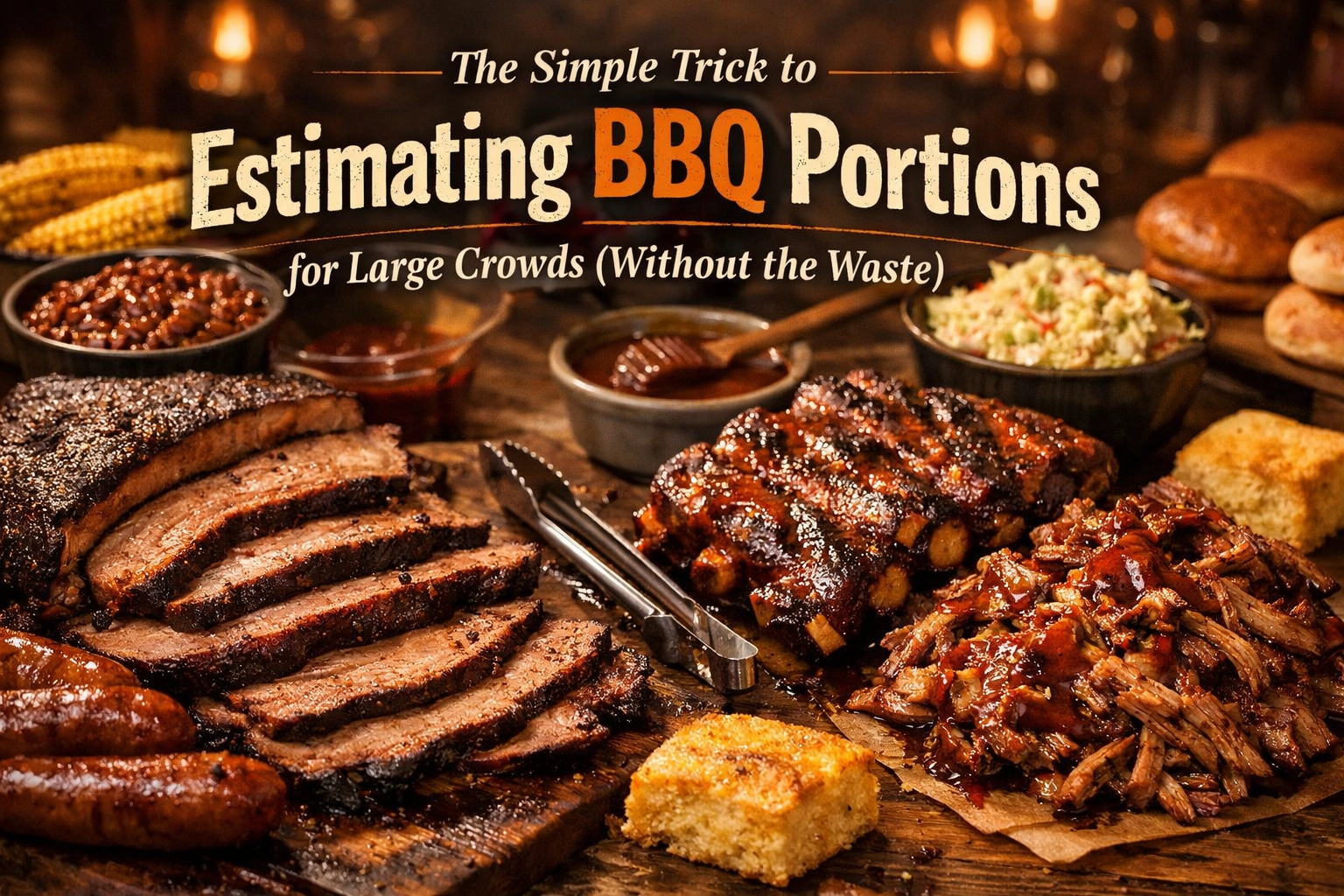
Hosting a large-scale event in Connecticut involves complex logistics: the most common point of failure is food volume estimation.
Under-ordering leads to guest dissatisfaction and a breakdown in event flow. Over-ordering results in significant financial waste and logistical headaches regarding storage and disposal.
At King of Que BBQ, our operations are purpose-built for efficient group dining. We approach catering as a logistics challenge where precision is the primary objective.
Whether you are planning a corporate gathering in Southbury or a large-scale graduation party, understanding the mathematics of BBQ portions is essential for a successful outcome.
The Core Metric: The Half-Pound Rule
The most reliable starting point for any BBQ catering estimate is the weight of the protein.
For a standard buffet-style service, the baseline is 0.5 to 0.75 pounds of cooked meat per person. This is not a random figure: it is the industry standard for high-caliber fuel that ensures satiety without excessive leftovers.
It is critical to distinguish between raw weight and cooked weight. Professional pitmasters understand that meat shrinks during the long, slow smoking process.
A brisket can lose up to 40% of its weight due to moisture loss and fat rendering. If you calculate your needs based on raw weight, you will inevitably run short.

Adjusting for Protein Specifics
Not all meats are consumed at the same rate. The structure of the protein and the presence of bones significantly impact how much you should order.
Pulled Pork and Sliced Brisket
These are boneless, high-yield proteins. Because every ounce served is edible, you can lean toward the lower end of the estimation scale: approximately 0.5 pounds per guest. These items are the backbone of efficient catering logistics because they are easy to portion and retain heat effectively.
Charcoal Grilled Carne Asada
Our charcoal grilled carne asada is a high-demand item that typically sees faster consumption rates than traditional smoked meats. Because it is served in thin, flavorful strips, guests tend to take slightly more. We recommend budgeting 0.6 pounds per person when this is a primary protein.
Pollo Asado and Bone-In Chicken
Chicken presents a different logistical challenge due to bone weight. For bone-in pollo asado, the estimate must increase to 0.6 or 0.75 pounds per person. This accounts for the non-edible portions of the bird while ensuring the actual caloric intake remains consistent with other proteins.
Bone-In Ribs
Ribs are the most difficult to estimate because of the high bone-to-meat ratio. A full pound of raw ribs may only yield 5 to 6 ounces of actual meat. When ribs are on the menu, they should be calculated by the individual bone rather than by weight: typically 2 to 3 bones per person in a multi-protein buffet.
The Side Dish Variables
Side dishes are more than just accompaniments: they are essential volume regulators for your event.
The volume of meat required is inversely proportional to the number of substantial sides provided. If you serve three or more heavy sides, you can safely reduce your meat estimate by 15%.
Mexican Style Street Corn (Elote)
Items like our Mexican style street corn are heavy hitters in terms of satiety. Because elote is dense and highly flavorful, it acts as a significant "fill factor" for guests. When serving street corn alongside proteins like carne asada, the overall meat consumption per guest typically stabilizes toward the lower 0.5-pound mark.
The Role of Starchy Sides
Mac and cheese, potato salad, and beans are logistical anchors. They provide the necessary carbohydrates to balance the high protein content of the BBQ. We recommend 4 to 6 ounces of each side dish per person.

Demographics and Event Duration
Precision estimation requires an analysis of who is eating and for how long.
The Guest List
An event populated primarily by adult males with high-performance roles will require a 10–15% increase in total volume. Conversely, events with a high percentage of young children or seniors should see a 20% reduction in meat volume.
The Time Factor
The longer the event, the more people will eat. A standard two-hour lunch window follows the 0.5-pound rule strictly. However, if the event spans four to six hours: such as a wedding or a full-day corporate retreat: guests will often return for a "second pass." In these scenarios, we increase the yield by 20% to account for grazing.
Professional Execution and Waste Mitigation
King of Que BBQ is a catering-first model. We do not just cook food: we manage the flow of the meal to ensure maximum efficiency.
Foolproof Quantity Planning With Online Ordering
If you are using our full-service catering online ordering system, the portion math is handled automatically.
It is built to remove the two most common planning failures:
- Under-ordering – the system scales quantities based on guest count, proteins, and sides.
- Over-ordering – the system prevents “panic padding” by keeping portions aligned with proven service ranges.
For hosts, this means:
- No manual spreadsheets – you do not have to convert guest counts into pounds and trays.
- Cleaner approvals – you can confirm the order with confidence before it hits the production schedule.
- More predictable execution – the kitchen and service plan match the quantities from the start.
Avoiding the "Empty Tray" Syndrome
The fear of running out of food often leads hosts to over-order by 30% or more. This is an inefficient use of budget.
By utilizing our professional catering services, you leverage our historical data on consumption patterns across Connecticut. We know exactly how much food a crowd of 200 requires because we have fueled those crowds hundreds of times.

The Simple Estimation Formula
To simplify your planning, use this logic-driven checklist:
- Determine Guest Count: Be as accurate as possible with RSVPs.
- Select Proteins: Choose 2–3 options for variety.
- Apply the Multiplier: 0.5 lbs (boneless) or 0.75 lbs (bone-in) per person.
- Adjust for Sides: Reduce meat by 15% if serving 3+ sides.
- Adjust for Duration: Increase by 10% for every hour over the initial two.
- Calculate Total: (Guest Count x Adjusted Multiplier) = Total Cooked Weight Required.
Mission-Ready Catering Solutions
At King of Que BBQ, we provide high-caliber fuel for your most important events. We understand that your reputation as a host depends on the reliability and quality of the meal.
Our team manages the logistics from preparation to service, allowing you to focus on the objectives of your event rather than the volume of the brisket.
If you are ready to plan an event that is efficient, professional, and free of waste, we are ready to execute. Our experience with local Connecticut events ensures that your portions will be exact.

Secure Your Date
Proper estimation is only half the battle: the other half is securing a team capable of delivering on those numbers.
King of Que BBQ operates with a focus on dependability and professional-grade production. We invite you to view our origin story to understand our commitment to the craft and our community.
To begin the logistical planning for your next large-scale BBQ event, contact us today for a detailed assessment of your needs.