Subtotal $0.00
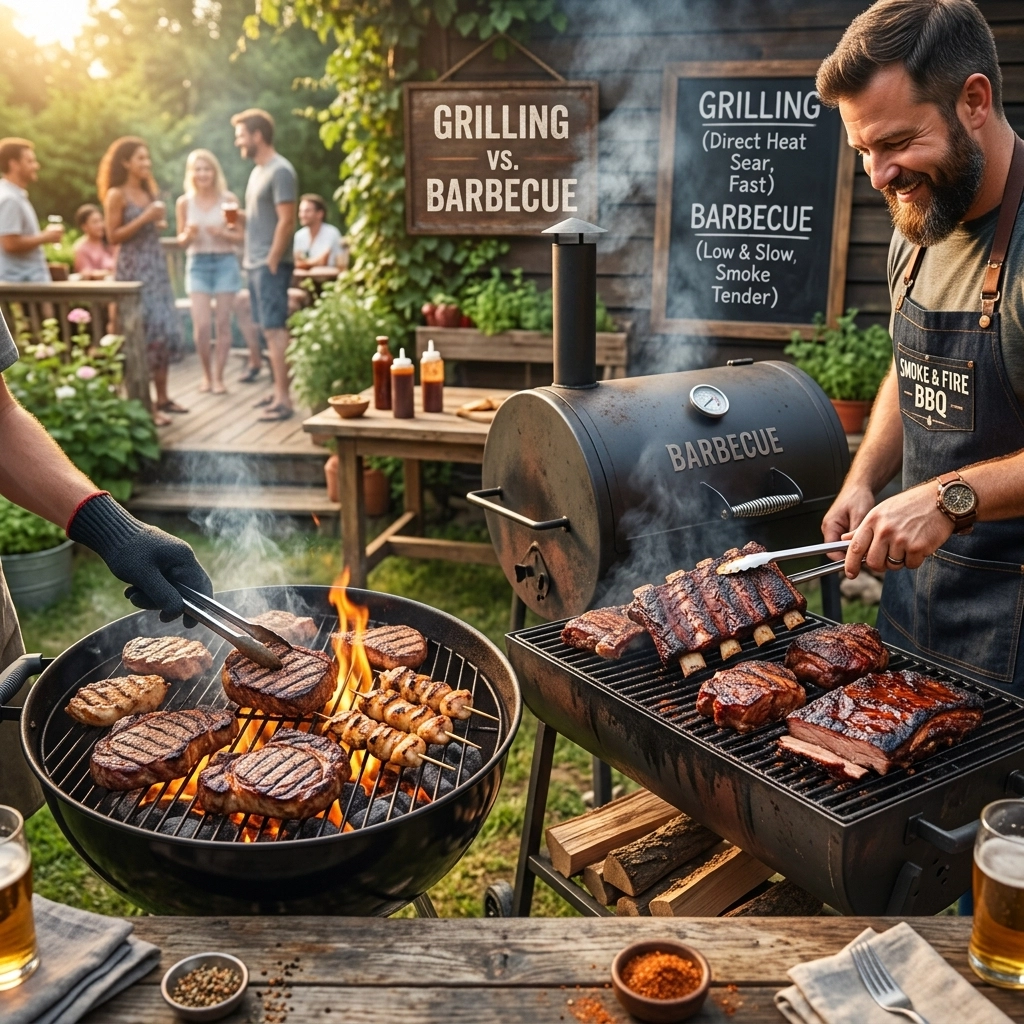
Most people in the Northeast use the terms "grilling" and "barbecue" interchangeably.
If you invite friends over for burgers and hot dogs, you likely tell them you are hosting a BBQ.
In the world of professional pitmasters and high-caliber food production, these two methods are fundamentally different operations.
Using the wrong terminology might seem like a minor linguistic slip: but from a culinary and logistical standpoint, the distinction is massive.
At King of Que BBQ, we specialize in the "low and slow" tradition, and understanding this difference is key to planning your next event.
Whether you are looking for bbq catering ct or simply want to master your own backyard, knowing the science of the smoke matters.
The Definition of Grilling: Hot and Fast
Grilling is the most common form of outdoor cooking found in suburban backyards across Connecticut.
It involves cooking food quickly over a direct heat source: usually charcoal or gas: at temperatures ranging from 400°F to 700°F.
The goal of grilling is to sear the exterior of the meat, creating a crust through the Maillard reaction while keeping the inside juicy.

Common Grilling Characteristics
- Heat Source: Direct heat located immediately beneath the food.
- Temperature: High heat, often exceeding 500°F on the grate.
- Time: Measured in minutes rather than hours.
- Cuts of Meat: Naturally tender cuts like steaks, burgers, hot dogs, and chicken breasts.
- Lid Position: Often left open to monitor the sear, or closed briefly to prevent flare-ups.
Grilling is a high-intensity, short-duration task that requires constant attention to prevent burning.
It is the ideal method for the Carne Asada profile or a quick weeknight meal.
The Definition of Barbecue: Low and Slow
True barbecue: the kind we provide through our full-service catering: is a completely different logistical animal.
Barbecue is a method of cooking meat "low and slow" using indirect heat and the addition of wood smoke.
Temperatures typically hover between 225°F and 275°F for the duration of the cook.
This process is designed to transform tough, fatty cuts of meat into tender, flavor-dense masterpieces.
Common Barbecue Characteristics
- Heat Source: Indirect heat, often located in a separate firebox or offset from the meat.
- Temperature: Low, stable heat, ideally maintained around 225°F–250°F.
- Time: Measured in hours: anywhere from 4 to 16 hours depending on the cut.
- Cuts of Meat: Tough, collagen-rich cuts like brisket, pork shoulder (pulled pork), and ribs.
- Lid Position: Closed tightly to trap heat and circulate smoke around the meat.
In this scenario, the smoke acts as an ingredient: seasoning the meat as it slowly breaks down connective tissues.
This is the standard we maintain for all barbecue catering ct orders.

The Technical Differences: A Deep Dive
To understand why your backyard cookout isn't actually BBQ, we need to look at the physics of the pit.
1. Heat Transfer Mechanics
Grilling relies heavily on radiation and conduction: the direct transfer of energy from the flame to the metal grate and then to the meat.
Barbecue relies on convection: the circulation of hot, smoky air around the meat, much like a wood-fired oven.
This convective environment is what allows for even cooking over long periods without scorching the exterior.
2. Meat Science and Collagen
If you were to "grill" a beef brisket over direct high heat for 15 minutes, it would be inedible: tough, rubbery, and impossible to chew.
Tougher cuts of meat are filled with collagen, a structural protein that only melts into gelatin when exposed to low heat over a long period.
This transition usually begins around 160°F and finishes near 200°F internal temperature.
Barbecue is the process of managing this internal transformation without drying out the meat.
3. The Role of Smoke
In grilling, any smoke produced is usually the result of fat dripping onto the coals: an accidental byproduct.
In barbecue, smoke is a mission-critical component of the flavor profile.
We use specific hardwoods: like oak, hickory, or fruitwoods: to impart specific notes into the meat during the long cook.
Without the smoke and the time, it simply isn't barbecue.
Why This Matters for Your Event
When you are planning an event in Connecticut, the terminology you use impacts the logistics and the guest experience.
If you tell a caterer you want a "BBQ," but you are actually looking for burgers and hot dogs, there can be a disconnect in expectations.
True barbecue catering ct requires significantly more lead time and preparation than a standard grill-out.

Logistical Considerations for BBQ Catering
- Prep Time: Briskets often need to be seasoned and started 12 to 15 hours before the event begins.
- Equipment: True BBQ requires smokers or pits, not just standard commercial grills.
- Portioning: Because BBQ meats shrink significantly during the long cook, professional "Meat Math" is required to ensure enough food for every guest.
- Side Pairings: Traditional BBQ is often accompanied by specific sides like cornbread or pit-style beans that complement the smoky flavor.
Our team at King of Que BBQ treats every order as a logistics-first operation.
Whether you are checking our classic combos or requesting a custom quote, we prioritize the "low and slow" method for maximum quality.
The Cultural Confusion
The confusion between grilling and barbecue is largely regional.
In the Southern United States, the distinction is strictly enforced: barbecue is a noun, a specific food group, and a cooking method involving wood smoke.
In the Northeast, "barbecue" has become a catch-all term for any social gathering involving outdoor cooking.
At King of Que BBQ, we aim to bridge that gap by bringing authentic, pit-smoked excellence to our local community.
We appreciate the casual backyard cookout: there is a time and place for a high-quality burger: but we want our clients to know the depth of craft involved in true pitmastery.
Identifying Authentic BBQ
How can you tell if what you are eating is actually barbecue or just grilled meat with sauce?
Look for the "Smoke Ring": a pinkish layer just beneath the surface of the meat.
This is a chemical reaction between the meat’s myoglobin and the carbon monoxide/nitric oxide in the wood smoke.
Also, check the texture: ribs should be tender enough to pull cleanly off the bone but still have a slight "tug."
Pulled pork should be moist and easily shredded with a fork, never mushy or dry.
These results cannot be achieved on a standard gas grill in 20 minutes.

Choosing the Right Style for Your Event
If you are hosting a quick office lunch or a casual neighborhood get-together, grilling might be the efficient choice.
However, if you want a high-caliber dining experience that serves as a focal point for your event, true barbecue is the solution.
Barbecue creates a sense of occasion: the aroma of the wood smoke and the visual of the sliced brisket are unmatched in the catering world.
You can explore our menu to see the range of "low and slow" options we offer for events of all sizes.
From corporate gatherings to weddings, we provide the hardware and the expertise to execute a flawless meal.
Final Verdict: Know Your Method
Terminology matters because it sets the standard for quality.
Grilling is about speed, high heat, and searing: it is a valid and delicious cooking style.
Barbecue is about patience, smoke, and the transformation of tough cuts into culinary gold.
Next time you plan a "BBQ," ask yourself if you want it grilled or if you want it smoked.
If you are looking for the latter, King of Que BBQ is mission-ready to help.
Check our event schedule to see where we are headed next, or contact us to bring the smoke to your next Connecticut event.
Don't settle for a backyard cookout when you can have a pitmaster-crafted experience.
Visit our online shop or request a quote today to secure your date on our calendar.